Explore
the e‑commerce layer
built for Odoo

Performance under load, B2B depth and EU-market localization — for anyone evaluating INODEO in detail, customer or partner.

Built to score green,
not just feel fast

Server-side rendering

Pages appear almost instantly, then stay smooth as customers browse - no reloads between clicks.

Optimized for strong Core Web Vitals

Fast load times and smooth interactions - good for conversion and SEO alike.

Handle more storefront traffic without overloading Odoo

The frontend and selected services can scale independently from the ERP backend.

Smart caching

Prices and static content are cached, cutting heavy queries against your Odoo database.

For complex company structures

Customer-specific pricing

Each B2B customer sees their own prices and conditions, driven by your Odoo pricelists.

Volume pricing

Quantity-discount tables shown clearly on the product page, straight from Odoo.

Custom catalogs

A key account sees only the products and prices contracted for them.

Multi-language,
one backend

Sell across markets in several languages and currencies from a single Odoo core.

Kits & bundles (BoM)

Odoo bill-of-materials shown clearly as a bundle of its component products.

Re-order
& quick order

Order history with quick re-add to cart for customers buying the same items repeatedly.

Book a demo

Built for multi-market European commerce

Local carriers & payments

Connect the shipping and payment methods your markets expect, with per-market options in the cart.

Omnibus & cross-border VAT

Price-history display and VAT handling that follows the delivery country.

EAA accessibility (WCAG)

Readable, keyboard-navigable, screen-reader friendly by default.

GDPR & Consent Mode v2

Analytics & marketing scripts blocked until explicit visitor consent.

Modern cart,
modern habits

Fully customizable checkout

A premium checkout flow you can shape to your market — steps, fields, shipping and payment options.


Free-shipping progress bar

A visual nudge in the cart to add one more item and unlock free delivery.


Cart sharing
& device sync

Share a cart link with anyone, and let logged-in customers pick it up on any device.


Self-service
returns (RMA)

Customers open a return request from their order, and it lands straight in Odoo.
Media delivery

without slowing down Odoo

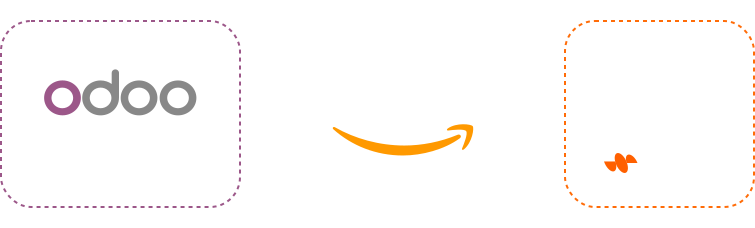
Media assets stored on Amazon S3

Automatic resizing & compression per device

Frontend never pulls media from your Odoo server

Core commerce essentials

Multilingual & Multicurrency

Discount & coupon codes

Free-shipping threshold

Wishlist

Alternative units of measure

Product reviews & ratings

Order tracking

Gifts

Related products

Optional products

Accessories

Product comparison

Warranty

Delivery date & expected restock

Google & Facebook signup

Performance & architecture

Server-side rendering

90+ PageSpeed

Sub-second TTFB

Decoupled scaling

Smart caching

CDN-hosted media (S3)

Automated Asset Optimization

Search & discovery

Typo-tolerant Smart Search

Scales past 100k SKUs

Instant filtering

Category-specific filters built from product attributes

Real-time stock availability in listings

Live filters, no reindex delay

B2B & enterprise

Customer-specific B2B pricing

VAT-exclusive price mode

Kits & bundles (BoM)

Re-order

Downloadable product documents

Localization & EU compliance

Multi-domain, one per language

Local carriers & payment methods

Omnibus price display

Cross-border VAT (OSS)

EAA accessibility (WCAG)

GDPR & Consent Mode v2

Conversion & cart UX

Express checkout

Free-shipping progress bar

Cart sharing & device sync

Self-service returns (RMA)

Loyalty points

Abandoned-cart recovery

SEO

Archive pages for discontinued products (no 404s)

Schema.org rich snippets

Unique URLs per language

Sitemap support for large catalogs

FAQ

It does the opposite. The architecture is built specifically to take load off the ERP: prices and static content are cached, media is served from a CDN, and filtering and search are handled entirely by Elasticsearch without ever touching the Odoo database.

What reaches Odoo is what belongs there – real cart operations and real orders.

A dedicated Odoo module intercepts every upload. Product images, banners and PDF attachments are pushed to Amazon S3 automatically, compressed and resized into the resolutions needed for mobile and desktop along the way.

The storefront then serves all of it from the CDN, never from your Odoo server. Your ERP stops being a file server and gets on with business logic.

The storefront never touches card data. Payment is initialized on the order-received step and handled entirely inside the gateway’s own environment, so card numbers never pass through INODEO.

Customer data moves over a secured API straight into your Odoo, which remains the single system of record. Passwords are hashed by Odoo’s native mechanism, and sensitive values are masked in logs.

Because a connector means running two systems that each hold a copy of your catalog, your prices and your stock, and then paying – in fees and in maintenance hours – to keep them agreeing with each other. Sync errors and duplicate data are not edge cases in that setup, they are the normal weather.

INODEO isn’t a foreign platform bolted on. It is a native extension of Odoo, reading live data from the system you already trust – one catalog, one stock level, one source of truth.

Catalog browsing, filtering and search — the bulk of spike traffic – are absorbed by the storefront and Elasticsearch, so they never reach your ERP. Prices and static content are cached on top of that.

The result is that Odoo only scales for what it genuinely processes: orders being written. You are not forced to over-provision an ERP server to survive one night a year.

It stays intact. Discontinued products keep their original URL and the page remains live, showing that the item is no longer for sale instead of returning a 404 — which Google penalizes and which throws away rankings you paid to build.

The product disappears from the catalog, search, filters and the sitemap, so it never interferes with what customers can actually buy.

INODEO runs on Odoo 19 today, and Odoo 19 is our active development platform — new features ship there. The port to Odoo 20 is planned for Q4 2026.

We deliberately don’t release compatibility on launch day. With a major version we wait for the core to settle, then finalize our modules and migration scripts. We would rather be a few weeks later with something that holds up in production.

No, and that is by design. INODEO is built exclusively for Odoo and doesn’t run without it. Odoo stays the core system – products, pricing, stock, orders and accounting – and INODEO is the commerce layer in front of it.

That exclusivity is what makes the real-time connection possible. A platform built to support five different ERPs has to settle for the lowest common denominator of all of them.

See your Odoo,
as a real e-commerce platform

Book a demo and we'll walk through your specific case.

Your subscription could not be saved. Please try again.
Your subscription has been successful.